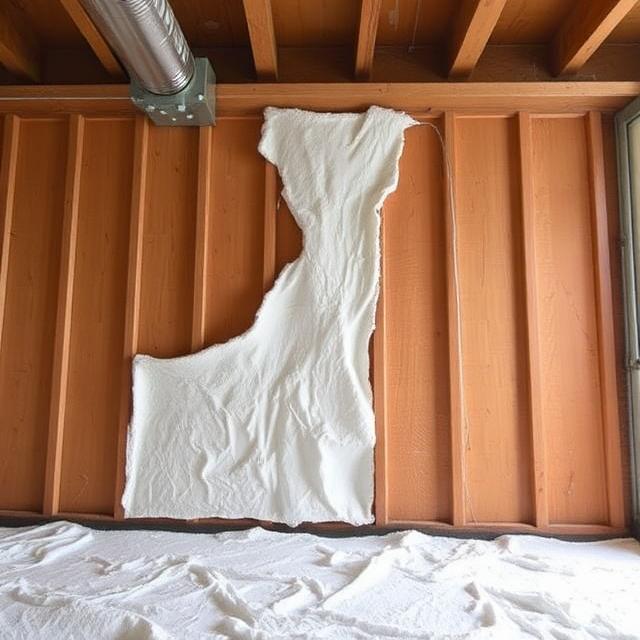
 What is Open Cell Spray Foam Insulation?
Open cell spray foam is a type of polyurethane insulation material that expands to fill cavities, cracks, and gaps in walls, attics, and other building structures. Unlike traditional insulation materials such as fiberglass batts or cellulose, this spray-applied foam creates an air-tight seal that significantly reduces air infiltration and improves energy efficiency. The term “open cell” refers to the foam’s cellular structure, where the tiny cells that make up the foam are not completely closed off from one another, creating a softer, more flexible material compared to its counterpart, closed cell spray foam.
When applied, open cell spray foam insulation starts as a liquid mixture of two chemical components that are combined at the spray nozzle. This mixture rapidly expands to approximately 100 times its original liquid volume within seconds of application. The expansion process allows the foam to conform to irregular surfaces, fill gaps around pipes and wiring, and create a continuous insulation barrier without the seams and gaps common in traditional insulation methods. The resulting foam has a spongy texture similar to a kitchen sponge, with interconnected cells that give the material its characteristic flexibility and sound-dampening properties.
The science behind open cell foam involves a chemical reaction between isocyanate and polyol resin, which produces carbon dioxide gas as a blowing agent. This gas becomes trapped within the foam structure, creating millions of tiny open cells. The density of open cell spray foam typically ranges from 0.4 to 0.5 pounds per cubic foot, making it significantly lighter than closed cell foam, which has a density of approximately 1.7 to 2.0 pounds per cubic foot. This lower density translates to different performance characteristics, cost considerations, and ideal applications that homeowners and builders must understand when selecting insulation materials for construction or renovation projects.
The Properties and Characteristics of Open Cell Spray Foam
R-Value and Thermal Performance
The R-value measures an insulation material’s resistance to heat flow, with higher numbers indicating better insulating performance. Open cell spray foam provides an R-value of approximately 3.5 to 3.7 per inch of thickness. While this R-value is lower than closed cell spray foam (which offers R-6 to R-7 per inch), open cell foam compensates through its superior air sealing capabilities and the ability to be applied in thicker layers due to its lower cost per square foot. A typical application of 5.5 inches of open cell foam in a standard 2×6 wall cavity provides an R-value of approximately R-19 to R-20, which meets or exceeds building code requirements in most climate zones.
The thermal performance of open cell spray foam insulation extends beyond simple R-value calculations. Traditional R-value testing measures conductive heat transfer but doesn’t fully account for air infiltration, which can account for 30-40% of heating and cooling costs in a typical home. Because open cell foam creates an effective air barrier at just 3.5 inches of thickness (meeting the 0.02 L/s·m² air leakage standard), it prevents convective heat loss that occurs when air moves through insulation. This air sealing capability means that a wall insulated with open cell foam at R-20 often performs similarly to a wall with fiberglass insulation rated at R-25 or higher, due to the elimination of air movement through the wall assembly.
Sound Absorption and Acoustic Properties
One of the most significant advantages of open cell spray foam that often goes overlooked is its exceptional sound-dampening capability. The open cell structure acts as an excellent sound absorber, with the interconnected cells trapping and dissipating sound waves as they pass through the material. Testing has shown that open cell spray foam can reduce sound transmission by 80% or more compared to traditional insulation methods. This makes it an ideal choice for interior walls between rooms, walls separating living spaces from garages, home theaters, music rooms, and any application where noise reduction is a priority alongside thermal performance.
The Noise Reduction Coefficient (NRC) of open cell spray foam typically ranges from 0.70 to 0.75, meaning it absorbs 70-75% of sound energy that strikes its surface. For comparison, fiberglass batt insulation has an NRC of approximately 0.50, while closed cell spray foam scores around 0.35-0.45. This superior acoustic performance makes open cell foam insulation particularly valuable in multi-family housing, commercial buildings, and residential applications where occupant comfort depends on sound isolation. Architects and builders increasingly specify open cell foam for interior partition walls specifically for its sound control benefits, even in situations where thermal insulation isn’t the primary concern.
Vapor Permeability and Moisture Management
Open cell spray foam is classified as a vapor-permeable insulation material, with a permeance rating that allows water vapor to pass through it more readily than closed cell foam. At standard installation thickness (5.5 inches), open cell foam typically has a perm rating of approximately 16 perms, compared to closed cell foam which acts as a vapor barrier at less than 1 perm. This vapor permeability is both an advantage and a consideration that must be carefully evaluated based on climate zone and building design.
In cold climates, the vapor permeability of open cell spray foam means that building codes typically require the installation of a separate vapor retarder on the warm (interior) side of the insulation. However, this permeability also allows walls to dry toward the interior if moisture does accumulate in the wall cavity, providing a safety margin that can prevent long-term moisture problems.
In hot, humid climates, the vapor permeability allows walls to dry toward the interior when air conditioning systems create lower indoor vapor pressure, helping to manage moisture in wall assemblies that might otherwise trap humidity. This breathability characteristic makes open cell foam particularly well-suited for certain climates and building types where moisture management strategy includes drying potential in multiple directions.
Suggested read: Athlete's Foot Spray: Treatment Options and How to Use Them
Open Cell vs Closed Cell Spray Foam: A Detailed Comparison
Structural Differences and Density
The fundamental difference between open cell and closed cell spray foam lies in their cellular structure at the microscopic level. In open cell foam, approximately 50-70% of the cells are broken or open, creating a network of interconnected spaces filled with air. This structure gives the material its soft, spongy texture and lower density. Closed cell foam, conversely, has nearly 100% of its cells intact and closed, filled with a gas (usually a hydrofluorocarbon) that has better insulating properties than air. These closed cells are tightly packed, creating a rigid, dense material that feels hard to the touch.
| Property | Open Cell Spray Foam | Closed Cell Spray Foam |
|---|---|---|
| Density | 0.4-0.5 lbs/cu ft | 1.7-2.0 lbs/cu ft |
| R-Value per inch | 3.5-3.7 | 6.0-7.0 |
| Expansion ratio | 100:1 | 30-40:1 |
| Texture | Soft, flexible | Rigid, hard |
| Vapor permeability | ~16 perms (5.5″) | <1 perm (2″) |
| Cost per board foot | $0.44-$0.65 | $1.00-$1.50 |
| Water absorption | Moderate | Minimal |
| Structural strength | Minimal | Adds 200-300% racking strength |
The density difference has significant practical implications. A 2,000 square foot home insulated with open cell spray foam to a depth of 5.5 inches in the walls would require approximately 900-1,000 pounds of cured foam. The same home insulated with closed cell foam at 3 inches would require approximately 2,100-2,400 pounds of material. This weight difference rarely causes structural concerns in either case, but it does affect transportation costs, storage requirements, and the physical effort required during installation.
Performance in Different Climate Zones
Open cell spray foam insulation performs optimally in specific climate conditions and building types. In Climate Zones 1-4 (warm to mixed climates), open cell foam excels because its vapor permeability allows walls to dry toward the interior during hot, humid periods when exterior vapor pressure is higher than interior pressure. This drying capacity helps prevent moisture accumulation that could lead to mold growth or structural damage. Many building scientists recommend open cell foam for these zones specifically because of this moisture management characteristic, particularly in air-conditioned buildings where the vapor drive is typically from exterior to interior.
In Climate Zones 5-8 (cold climates), the choice between open and closed cell spray foam becomes more nuanced. Building codes in these zones typically require vapor retarders on the interior side of wall assemblies to prevent warm, moist interior air from condensing within the cold portions of the wall. When open cell foam is used in these climates, it must be combined with a separate vapor retarder (such as a polyethylene sheet or vapor-retardant paint) to meet code requirements.
Alternatively, builders can use closed cell foam, which acts as both insulation and vapor barrier. However, many experienced builders in cold climates still prefer open cell foam with a proper vapor retarder because it costs less, provides better sound control, and offers moisture safety through its ability to dry toward the interior if any leaks occur.
Cost Analysis and Return on Investment
The cost differential between open cell and closed cell spray foam significantly impacts project budgets and return on investment calculations. On average, open cell foam costs approximately $0.44 to $0.65 per board foot (a board foot is one square foot at one inch thickness), while closed cell foam costs $1.00 to $1.50 per board foot. For a typical 2,000 square foot home requiring wall insulation, open cell foam might cost $4,500 to $6,500 for materials and installation, while closed cell foam could cost $11,000 to $18,000 for the same project.
Case Study: Residential Renovation Project
A homeowner in Atlanta, Georgia (Climate Zone 3) renovated a 1,800 square foot ranch home originally built in 1985 with fiberglass batt insulation. Before renovation, annual heating and cooling costs averaged $2,400. The homeowner obtained quotes for both open and closed cell spray foam:
- Open cell spray foam: $5,200 installed (5.5″ in walls, 10″ in attic)
- Closed cell spray foam: $14,800 installed (3″ in walls, 5″ in attic)
The homeowner chose open cell spray foam insulation and saw immediate results. First-year energy costs dropped to $1,450—a savings of $950 annually. At this savings rate, the open cell foam investment would pay for itself in 5.5 years. Had the homeowner chosen closed cell foam, the payback period would have been 15.6 years, despite the higher R-value, because the energy savings were similar due to the air sealing benefits being nearly equal between the two products. After seven years, the homeowner reported that the open cell foam maintained its performance, the home remained comfortable, and no moisture issues developed, validating the product choice for that climate zone.
Applications and Best Uses for Open Cell Spray Foam
Residential Wall Insulation
Open cell spray foam has become the preferred insulation choice for residential wall cavities in new construction and deep energy retrofits. When applied to wall cavities before drywall installation, the foam expands to fill every gap, void, and irregular space around electrical boxes, pipes, and framing members. This complete fill eliminates the air gaps that plague fiberglass batt installations, where even small gaps can reduce effective R-value by 25% or more. The 100-to-1 expansion ratio means that open cell foam can fill cavities of varying depths completely, accommodating the reality that wall cavities aren’t perfectly uniform in real-world construction.
Suggested read: Clear Coat Spray Paint: Professional Techniques, Applications, and Product Selection for Flawless Finishes
For exterior wall applications, open cell spray foam provides several advantages beyond thermal performance. The air-tight seal reduces dust infiltration, pollen entry, and insect access, creating a cleaner, healthier indoor environment. Homeowners with allergies or asthma often report significant improvement in symptoms after their homes are insulated with spray foam.
The material also reduces the whistling or drafty feeling near windows and doors that occurs with traditional insulation, even when those windows and doors themselves are relatively new and well-sealed. When combined with proper window flashing and air sealing details, open cell foam insulation in walls can help achieve extremely low air change rates, with properly executed installations reaching 1.0 air changes per hour at 50 Pascals pressure differential (1.0 ACH50) or lower.
Attic and Roof Deck Insulation
Installing open cell spray foam directly against the underside of roof decking creates an unvented attic assembly that transforms the attic from an unconditioned space into part of the building’s thermal envelope. This approach, sometimes called a “conditioned attic” or “unvented attic,” has gained popularity because it brings HVAC equipment and ductwork into the conditioned space, dramatically reducing energy losses from duct leakage and conductive heat transfer through duct walls. Studies by building science researchers have shown that moving ducts from a 130°F unconditioned attic to a 75°F conditioned attic can reduce cooling loads by 15-30%, depending on climate and duct system efficiency.
The typical application thickness for open cell spray foam in attic roof deck applications ranges from 7 to 10 inches, providing R-24 to R-35, which meets or exceeds building code requirements for most climate zones. The installation process involves spraying foam directly onto the underside of the roof sheathing, creating a continuous layer that seals all the penetrations where roof framing members meet the top plates of walls—a notorious source of air leakage in traditional vented attic designs. Unlike batt insulation, which can shift, settle, or leave gaps around roof trusses, open cell spray foam maintains its position and air sealing properties indefinitely once cured.
One consideration for roof deck spray foam applications is ensuring adequate ventilation for roofing materials. While the conditioned attic approach eliminates the need for soffit and ridge vents (which would compromise the sealed envelope), building codes in some jurisdictions require special approvals or impose specific requirements for unvented roof assemblies. Builders must follow manufacturer specifications and local codes regarding vapor retarders, roof covering types compatible with sealed roof decks, and minimum R-values. When properly installed according to these requirements, open cell spray foam roof deck insulation provides reliable performance for decades.
Interior Wall Sound Control
Beyond thermal applications, open cell spray foam has emerged as a premium solution for sound control in interior walls. The material’s ability to absorb and dampen sound makes it ideal for walls between bedrooms, bathrooms, home offices, media rooms, and any space where privacy or noise reduction is valued. Traditional fiberglass batt insulation in interior walls provides minimal sound control because it doesn’t seal the gaps around electrical boxes, pipes, and wall penetrations—gaps that allow sound to pass through readily. Open cell foam completely seals these pathways while providing superior sound absorption through its structure.
Professional acoustic consultants often specify open cell spray foam for high-performance applications where Sound Transmission Class (STC) ratings must meet specific targets. A standard 2×4 interior wall with 1/2″ drywall on each side has an STC rating of approximately 33 without insulation. Adding fiberglass batts increases this to approximately STC 39. Installing open cell foam insulation in the same wall typically achieves STC 44-46, representing a substantial improvement in sound isolation. For context, an STC increase of 10 points represents a perceived halving of loudness, so the difference between STC 39 and STC 46 is quite noticeable to occupants.
The sound control benefits extend to floors and ceilings as well. Installing open cell spray foam in floor joist bays between levels of a home reduces footfall noise, conversation transmission, and plumbing noise that travels through the structure. This application is particularly valuable in multi-story homes, basement finishing projects, and renovations where homeowners want to improve privacy between floors without the expense of demolishing and rebuilding floor assemblies. Some municipalities have adopted building codes requiring minimum STC ratings for multi-family housing, and open cell spray foam has become a go-to solution for builders meeting these requirements cost-effectively.
Commercial and Industrial Applications
Open cell spray foam finds extensive use in commercial buildings, warehouses, retail spaces, and light industrial facilities where cost-effective insulation and air sealing must be balanced with performance requirements. Metal buildings particularly benefit from open cell foam application because the material adheres well to metal surfaces, seals the seams and fasteners that create air leakage, and prevents the condensation problems that plague metal buildings insulated with fiberglass batts. The foam’s expansion allows it to fill the flutes and ribs of metal wall panels completely, something virtually impossible with traditional insulation methods.
In agricultural buildings, such as barns, equipment storage facilities, and workshops, open cell spray foam provides thermal comfort and condensation control at a lower cost than closed cell alternatives. These buildings typically don’t require the maximum possible R-value per inch, making open cell foam’s lower cost per R-value attractive. Farmers report that livestock buildings insulated with open cell spray foam insulation maintain more stable temperatures with less energy input, reducing animal stress and improving productivity. Equipment storage buildings benefit from reduced condensation on stored machinery and tools, preventing rust and corrosion that shortens equipment life.
Suggested read: The Ultimate Spray Tan Scrub: How to Prep, Maintain, and Remove Your Golden Glow
Renovation and retrofit projects in commercial buildings frequently specify open cell foam because it can be applied to irregular surfaces, around existing utilities, and in spaces with limited access more easily than rigid foam boards or fiberglass. The material’s ability to conform to substrate irregularities makes it ideal for older buildings where walls may be out of plumb, surfaces may be damaged, or framing may be non-standard. Building owners appreciate that open cell foam installation is typically faster than alternative methods, reducing the time that building spaces must be taken out of service during renovation work.
Installation Process and Requirements for Open Cell Spray Foam
Equipment and Safety Protocols
Installing open cell spray foam requires specialized equipment and trained technicians due to the chemical nature of the materials and the precision required for proper application. Professional spray foam contractors use high-pressure plural-component proportioning equipment that mixes the isocyanate (A-side) and polyol resin (B-side) components at the spray gun in precisely controlled ratios. These systems heat the chemicals to optimal temperatures (typically 120-140°F) before mixing, ensuring proper reaction chemistry and foam performance. The equipment investment for a professional spray foam rig ranges from $35,000 to $75,000, which is why spray foam installation is typically performed by specialized contractors rather than general insulation companies.
Safety considerations during installation are paramount. The chemicals used in spray foam are highly reactive and potentially hazardous before they cure. Installers must wear full personal protective equipment including respirators with appropriate cartridges, protective suits, gloves, and goggles. The building being sprayed must be properly ventilated, and occupants must vacate the premises during application and for a specified period afterward (typically 24 hours) while the foam off-gases and cures completely. These safety requirements are not merely recommendations but are mandated by OSHA regulations and spray foam industry standards. Reputable contractors follow these protocols rigorously to protect both their workers and building occupants.
The curing process for open cell spray foam occurs in two stages. The initial rise and stabilization happen within 30-60 seconds of application, during which the foam expands to its full volume and begins to firm up. However, full cure takes 24-48 hours, during which the chemical reaction continues and the foam hardens completely. During this cure period, the foam off-gases various compounds, including residual unreacted chemicals and reaction byproducts. Proper ventilation during this period is essential. Once fully cured, open cell spray foam insulation becomes chemically inert and does not off-gas significantly, making it safe for long-term exposure in occupied buildings.
Surface Preparation and Application Techniques
Proper surface preparation is critical for successful open cell spray foam installation. Surfaces must be clean, dry, and within the temperature range specified by the manufacturer (typically 40-120°F for the substrate). Installers begin by masking areas that shouldn’t receive foam, including window and door frames, electrical panels, and any fixtures that will remain exposed. They also install dams or stops at the termination points where foam application will end, ensuring clean, professional-looking edges.
Application technique significantly affects the performance and coverage efficiency of open cell spray foam. Professional installers apply the foam in multiple passes, building up thickness gradually rather than attempting to achieve full depth in a single pass. Each pass is typically 2-3 inches thick, with subsequent passes applied once the previous layer has risen and stabilized (approximately 30-60 seconds). This multi-pass technique prevents overheating in thick sections, ensures proper adhesion between layers, and allows the installer to achieve consistent density throughout the installation. Attempting to apply too much foam in a single pass can cause the foam to collapse, shrink, or develop voids—defects that compromise insulation performance.
The skill of the installer dramatically impacts the quality of open cell spray foam installations. Experienced technicians understand how to adjust equipment settings for ambient temperature and humidity conditions, recognize when foam is off-ratio (indicated by color, texture, or rise rate issues), and know how to handle challenging installation scenarios like cathedral ceilings, rim joists, and complex framing geometries.
They also understand building science principles, such as the importance of maintaining thermal envelope continuity, avoiding thermal bridges, and integrating the spray foam with other building components like weather-resistant barriers and air barriers. Homeowners and builders should verify that spray foam contractors hold appropriate certifications from organizations like the Spray Polyurethane Foam Alliance (SPFA) and have verifiable references from recent projects.
Common Installation Mistakes to Avoid
Several installation errors can compromise the performance of open cell spray foam insulation. One of the most common mistakes is applying foam that is off-ratio—meaning the two chemical components aren’t mixed in the correct proportions. Off-ratio foam may appear normal initially but can shrink over time, develop an unusual smell, or fail to achieve proper R-value. Indicators of off-ratio foam include a very strong chemical odor that persists beyond the normal cure period, foam that is excessively friable (crumbles easily), or foam that has a distinct color tint (properly mixed open cell foam is typically light tan or white).
Overspray and contamination represent another category of installation problems. During application, a fine mist of uncured chemicals can settle on surfaces throughout the work area. This overspray can be difficult to remove from windows, flooring, and fixtures, potentially causing permanent damage or staining. Professional installers minimize overspray through proper equipment setup, appropriate spray patterns, and thorough masking of sensitive areas. They also use containment barriers to isolate the spray area from finished portions of the building.
Suggested read: How Long Do Spray Tans Last? Everything You Need to Know About Spray Tan Duration
Insufficient thickness is a mistake that sometimes occurs when contractors under-apply foam to save money or due to equipment problems. Because open cell spray foam has a lower R-value per inch than closed cell foam, adequate thickness is essential to meet building code requirements and achieve promised energy performance. A wall cavity that should receive 5.5 inches of foam but only receives 3.5 inches will fall significantly short of its intended R-value and may not meet the minimum thickness required for air barrier certification. Building inspectors increasingly use probes to verify spray foam thickness, and homeowners should also verify that installed thickness matches contract specifications before making final payment to contractors.
Cost Factors and Economic Considerations for Open Cell Spray Foam
Material and Labor Cost Breakdown
The total installed cost of open cell spray foam insulation reflects several cost components beyond just the raw materials. Material costs typically represent 30-40% of the total project cost, with the remainder covering labor, equipment, overhead, and contractor profit. For open cell spray foam, material costs range from $0.18 to $0.28 per board foot for the chemicals themselves. However, the installed price that homeowners and builders pay ranges from $0.44 to $0.65 per board foot on average, with significant regional variation.
Labor and equipment costs account for the larger share of spray foam pricing. The specialized equipment required for spray foam installation must be transported to the job site, set up, calibrated, and operated by trained technicians. A typical residential installation might require a crew of 2-3 people working for 6-10 hours, depending on the square footage and complexity. The crew must prepare the site, apply the foam, clean up overspray, and ensure proper cure before departing. These labor requirements, combined with the equipment investment and ongoing equipment maintenance costs, explain why spray foam installation is significantly more expensive than traditional insulation methods on a per-square-foot basis.
Regional variation in open cell spray foam pricing can be substantial. Urban markets with multiple competing spray foam contractors typically offer lower prices than rural areas where contractors must travel significant distances to reach job sites. Coastal markets and cold climate zones tend to have higher prices due to greater demand and higher labor costs. Additionally, project size significantly affects per-board-foot pricing. Large commercial projects or new home subdivisions can achieve pricing as low as $0.35-$0.45 per board foot due to economies of scale, while small residential retrofit projects might pay $0.75-$1.00 per board foot or more for the same material because setup and minimum charge considerations affect small jobs disproportionately.
Comparing Costs to Alternative Insulation Methods
To properly evaluate the cost-effectiveness of open cell spray foam insulation, it must be compared to alternative insulation methods on a whole-house, whole-system basis rather than just material cost per R-value. While fiberglass batt insulation costs only $0.40-$0.70 per square foot installed compared to $1.25-$2.00 per square foot for open cell spray foam, this comparison doesn’t account for the air sealing benefits that spray foam provides. Achieving similar air tightness with fiberglass requires additional air sealing work, including caulking all penetrations, sealing electrical boxes, and installing air barriers—work that adds $800-$1,500 to a typical new construction project.
Cellulose insulation, another common alternative, costs approximately $0.70-$1.10 per square foot when dense-packed into wall cavities. Dense-pack cellulose provides better air sealing than fiberglass batts but still doesn’t match the air tightness that open cell spray foam achieves. Additionally, cellulose can settle over time, leaving gaps at the tops of wall cavities, and it loses R-value when it becomes wet, whereas spray foam maintains its R-value even when exposed to moisture. When these performance differences are factored into long-term value calculations, the cost gap between cellulose and open cell spray foam narrows considerably.
| Insulation Method | Material Cost/sq ft | Installed Cost/sq ft | Typical R-Value | Air Sealing Quality | Moisture Sensitivity |
|---|---|---|---|---|---|
| Open Cell Spray Foam | $0.55-$0.90 | $1.25-$2.00 | R-3.7/inch | Excellent | Low |
| Closed Cell Spray Foam | $1.20-$1.80 | $2.50-$4.00 | R-6.5/inch | Excellent | Very Low |
| Fiberglass Batts | $0.20-$0.35 | $0.40-$0.70 | R-3.2/inch | Poor | High |
| Dense-Pack Cellulose | $0.35-$0.55 | $0.70-$1.10 | R-3.5/inch | Good | Moderate |
| Blown-In Fiberglass | $0.30-$0.50 | $0.60-$0.95 | R-2.5/inch | Fair | High |
For a 2,000 square foot home with 8-foot ceilings, wall insulation with open cell spray foam might cost $7,000-$9,000, compared to $3,500-$4,500 for fiberglass batts. However, the energy savings from spray foam typically amount to 20-40% reduction in heating and cooling costs, translating to $400-$800 annually in many climates. At these savings rates, the additional investment in spray foam pays for itself in 7-12 years, and the homeowner benefits from improved comfort, better sound control, and potentially higher resale value for the remainder of the time they own the home.
Energy Savings and Payback Period Analysis
Calculating the return on investment for open cell spray foam insulation requires analysis of multiple factors including climate zone, existing insulation levels, energy costs, HVAC system efficiency, and utility rate structures. Homes in extreme climates (very hot or very cold) see the most dramatic energy savings from spray foam insulation because the air sealing and thermal barrier reduce the load on HVAC equipment substantially. Moderate climates still benefit, but payback periods are typically longer because baseline energy costs are lower.
Computer energy modeling using programs like REM/Rate or BEopt can predict energy savings with reasonable accuracy when proper inputs are provided. These models account for the home’s specific characteristics including orientation, window area, shading, HVAC equipment efficiency, and insulation levels in all components of the building envelope. A typical analysis shows that upgrading from R-13 fiberglass batts to R-20 open cell spray foam in walls reduces annual energy consumption by 12-18%, while upgrading from R-30 blown fiberglass to R-32 open cell spray foam in attics reduces consumption by 8-12%. The exact savings depend heavily on whether the existing insulation is well-installed or has gaps, and whether the building envelope is currently air-tight or leaky.
Real-world performance data from field studies generally confirms or exceeds modeled predictions. A multi-year study by Oak Ridge National Laboratory tracking homes insulated with spray foam found that actual energy savings averaged 25-35% compared to pre-retrofit consumption, with homes in hot-humid climates seeing the highest savings due to reduced latent cooling loads. Homeowners reported not only lower utility bills but also improved comfort, with fewer hot and cold spots, reduced drafts, and more consistent temperatures between rooms. These comfort improvements, while difficult to quantify economically, represent real value that factors into the overall return on investment for open cell spray foam insulation.
Suggested read: Fly Spray: Everything You Need to Know About Effective Fly Control Solutions
Health, Safety, and Environmental Considerations
Indoor Air Quality and Off-Gassing
The indoor air quality implications of open cell spray foam insulation have been the subject of extensive research and some controversy. During installation and the initial cure period, spray foam chemicals emit volatile organic compounds (VOCs) and other byproducts that can cause respiratory irritation, headaches, and other health symptoms if occupants are exposed. This is why professional installations require building evacuation and proper ventilation during and immediately after application. Industry standards recommend that occupants remain away from the building for at least 24 hours after spray foam installation, and some contractors recommend 48-72 hours for sensitive individuals.
Once fully cured, open cell spray foam becomes chemically inert and does not continue to off-gas at significant levels. Multiple independent laboratory studies using environmental chamber testing have confirmed that fully cured spray foam emits VOCs at levels below detection limits or well below established health standards. However, a small percentage of installations experience ongoing odor issues due to off-ratio application, contamination during installation, or inadequate cure time before re-occupation. These problem installations can require remediation including additional ventilation, application of odor sealers, or in extreme cases, removal and replacement of the foam.
Sensitive individuals, including people with chemical sensitivities, asthma, or respiratory conditions, should take extra precautions around spray foam installations. These individuals should consider requesting that the contractor use materials certified by independent testing laboratories for low VOC emissions, extending the building vacancy period beyond the minimum 24 hours, and conducting an indoor air quality assessment before re-occupying the space. Some manufacturers now offer open cell spray foam formulations specifically designed for low-odor applications, using modified catalysts and blowing agents that reduce emissions during cure. While these premium products cost 10-15% more than standard formulations, they provide additional peace of mind for health-conscious homeowners.
Fire Resistance and Building Code Requirements
Open cell spray foam is combustible and requires protection by an approved thermal barrier in most building code applications. The International Building Code requires that spray foam insulation in occupied buildings be separated from the interior space by a minimum 15-minute thermal barrier, typically 1/2-inch gypsum wallboard (drywall). This requirement ensures that in the event of a fire, building occupants have sufficient time to evacuate before the foam contributes to the fire load. The foam itself has a flame spread rating typically in the range of 300-450, which is classified as a rapidly spreading material, though it does not support combustion on its own without an ignition source.
Fire-retardant additives in open cell spray foam formulations help limit flame spread and reduce smoke generation. Modern spray foam products include Class 1 fire-retardant chemicals that cause the foam to char and self-extinguish when the ignition source is removed. However, the foam will burn if continuously exposed to flame, producing dense black smoke and toxic gases including carbon monoxide, hydrogen cyanide, and various organic compounds. This fire behavior is similar to many other plastic building products, and the code-required thermal barrier effectively prevents the foam from becoming involved in a fire until very late in the fire’s development.
Special applications where spray foam will remain exposed, such as in crawl spaces, attics, or agricultural buildings, may require foam products that meet more stringent fire ratings or may require approval from local building officials. Some manufacturers produce ignition-resistant open cell spray foam formulations specifically for these applications. These products include additional fire retardants and have been tested to meet specific fire codes for exposure without thermal barriers. Builders and contractors must verify local code requirements and ensure that the specified foam product meets all applicable standards for the intended application. Building inspectors increasingly check for proper foam product selection and approved thermal barrier installation during construction inspections.
Environmental Impact and Sustainability
The environmental footprint of open cell spray foam insulation involves analysis of both the manufacturing process and the product’s lifetime performance. Spray foam production requires petroleum-based chemicals and energy-intensive manufacturing processes, giving it a higher embodied energy compared to cellulose or fiberglass insulation. However, this embodied energy is typically recovered through energy savings within 1-3 years of installation in most climate zones. Over a typical 50-year building lifespan, the energy saved by superior insulation and air sealing far exceeds the energy invested in manufacturing the foam.
Blowing agents used in open cell spray foam have environmental implications that have evolved over time. Early spray foam products used chlorofluorocarbons (CFCs) and later hydrochlorofluorocarbons (HCFCs) as blowing agents—chemicals that contributed to ozone depletion and had high global warming potential. Modern open cell spray foam uses water and carbon dioxide as blowing agents, which have zero ozone depletion potential and minimal global warming potential. This represents a significant environmental improvement compared to older formulations and even compared to current closed cell spray foam, which still uses hydrofluorocarbon (HFC) blowing agents with global warming potential 1,000-1,430 times greater than carbon dioxide.
Life cycle assessments comparing different insulation materials show that when energy savings over building lifetime are included, spray foam insulation often has a lower total environmental impact than alternatives, despite higher embodied energy. A study by the Spray Polyurethane Foam Alliance found that open cell spray foam insulation prevented the emission of greenhouse gases equivalent to 3.5-5 times its manufacturing emissions over a 50-year period in typical residential applications. The exact environmental benefit varies based on climate, the efficiency of the local electrical grid, and the insulation being replaced or compared against. Homeowners concerned about environmental impact should consider both embodied energy and operational energy in their decision-making, rather than focusing exclusively on one factor.
Maintenance and Long-Term Performance of Open Cell Spray Foam
Durability and Lifespan Expectations
Open cell spray foam insulation is remarkably durable when properly installed and protected from environmental challenges. The material does not settle, sag, or degrade under normal conditions, maintaining its full R-value and air sealing properties indefinitely. Field surveys of buildings insulated with spray foam 20-30 years ago show that the foam remains in excellent condition with no signs of deterioration, compression, or performance loss. This longevity represents a significant advantage over fiberglass batts, which can compress and lose R-value over time, or cellulose, which can settle and leave gaps in wall cavities.
Suggested read: Spider Spray: Everything You Need to Know About Choosing and Using the Right Spider Repellent
Water exposure is the primary environmental factor that can affect open cell spray foam performance. Because the foam has an open cell structure, it can absorb water if exposed to leaks or flooding. When this occurs, the foam acts like a sponge, holding moisture within its structure. While the foam itself is not damaged by water exposure and does not support mold growth, the prolonged moisture presence can create conditions for mold growth on adjacent wooden framing or other building materials.
If water exposure occurs, the foam must be allowed to dry completely, which can take several weeks depending on the thickness and environmental conditions. In cases of significant water damage, affected foam sections may need to be removed to allow inspection and remediation of underlying structural components.
Ultraviolet light exposure will degrade open cell spray foam over time, causing it to become brittle and lose integrity. For this reason, spray foam must always be protected from direct sunlight in applications where it could be exposed, such as in open-air structures or exposed foundation applications. The thermal barrier required by building codes (typically drywall) provides this UV protection in standard interior applications. For exterior applications or areas where UV exposure is unavoidable, closed cell spray foam or alternative insulation methods should be considered, as closed cell foam has better UV resistance than open cell products.
Inspection and Monitoring Recommendations
Homeowners with open cell spray foam insulation should conduct periodic visual inspections to ensure the foam remains in good condition and that no damage has occurred. Key areas to inspect include attic spaces where roof leaks might affect the foam, basement or crawl space installations where flooding risk exists, and any areas where mechanical systems or recent renovations might have disturbed the foam. During these inspections, look for signs of water staining on the foam surface, any areas where the foam appears to be pulling away from framing members, and any sections where the foam has been cut or damaged during service work on electrical or plumbing systems.
Moisture monitoring becomes important in situations where spray foam has been installed in areas prone to moisture exposure. In crawl spaces, basements, and attics, consider installing humidity monitors to alert you if moisture levels rise above acceptable thresholds (typically 60% relative humidity). Persistent high humidity can indicate problems with foundation drainage, roof leaks, or HVAC condensate disposal that need to be addressed before they cause damage to structural components or create mold growth conditions. While the open cell spray foam itself resists mold growth, the wooden framing it’s attached to does not.
Professional assessment may be warranted if you notice any unusual odors in your home, particularly if they seem to originate from wall or ceiling cavities containing spray foam. While fully cured foam should be odor-free, off-ratio installations or installations that were contaminated during application can develop odors over time, particularly when ambient temperatures rise in summer months. If persistent odors occur, consider having an indoor air quality professional conduct testing to identify the source and recommend remediation strategies. In some cases, the solution may be as simple as additional ventilation or application of odor-blocking primers on interior surfaces. In more severe cases, affected foam sections may need to be removed and replaced.
Addressing Damage and Making Repairs
Repairing open cell spray foam is generally straightforward when damage is localized. If foam has been cut away to access plumbing, electrical, or HVAC systems, the gaps can be filled with canned spray foam (single-component polyurethane foam available at hardware stores) for small voids, or professional spray foam contractors can be called to refill larger areas with the same two-component foam used in the original installation. The key is ensuring that any repairs restore the continuous air barrier and thermal envelope that the original installation created.
Partial removal of spray foam may be necessary in situations where water damage has affected wooden framing members behind the foam, or where renovations require access to building cavities. Open cell spray foam can be removed by carefully cutting it with a serrated knife or reciprocating saw with a wood blade. The foam releases from most surfaces relatively easily, though it adheres very strongly to rough wood surfaces. During removal, workers should wear respiratory protection because cutting foam can create airborne particles that are irritating if inhaled. After removal, the exposed framing should be inspected for damage, necessary repairs completed, and new foam installed to restore the thermal envelope.
Patching and touch-up work should be performed by experienced professionals when possible, particularly for larger areas. Small gaps and voids can be addressed by homeowners using one-component foam from hardware stores, but matching the density and performance of professional two-component open cell spray foam requires the proper equipment and expertise. When hiring contractors for repair work, ensure they understand the importance of maintaining air barrier continuity and thermal envelope performance, not just filling voids cosmetically.
Future Trends and Innovations in Open Cell Spray Foam Technology
Bio-Based and Sustainable Formulations
The spray foam insulation industry is increasingly developing bio-based polyol components derived from renewable resources rather than petroleum. These bio-based polyols can be produced from soybean oil, castor oil, or other plant-based oils, reducing the carbon footprint of spray foam production. Current formulations typically incorporate 10-30% bio-based content, with some premium products reaching 50% or higher bio-based polyol content. While these sustainable formulations cost modestly more than conventional products, they appeal to environmentally conscious builders and homeowners seeking to reduce the petroleum dependence of their building projects.
Suggested read: Rustoleum Spray Paint Safety Data Sheets: Everything You Need to Know for Safe Application
Performance characteristics of bio-based open cell spray foam match or exceed conventional formulations in most respects. Testing shows that bio-based foams achieve similar R-values, expansion ratios, and air sealing performance compared to 100% petroleum-based products. Some bio-based formulations actually demonstrate improved dimensional stability and reduced shrinkage over time compared to conventional foams. As production scales increase and bio-based feedstock costs decline, these sustainable spray foam options are expected to achieve price parity with conventional products within the next 5-10 years, potentially making them the standard rather than a premium option.
Regulatory pressure and consumer demand are accelerating the adoption of sustainable spray foam formulations. California has implemented strict VOC limits for spray foam products, effectively requiring manufacturers to reformulate products to meet these standards or exit the California market. Other states are considering similar regulations. Additionally, green building programs like LEED and the Living Building Challenge award points or require sustainable material choices, creating market pull for bio-based insulation products. Major spray foam manufacturers have announced commitments to increase bio-based content across their product lines, with some targeting 100% bio-based polyol content by 2030.
Smart Insulation and Performance Monitoring
Emerging technologies are beginning to incorporate sensor capabilities into building insulation systems, including spray foam. Researchers are developing spray foam formulations that can integrate conductive pathways or fiber optic sensors to monitor temperature, humidity, and moisture content within wall assemblies in real-time. These “smart insulation” systems could alert building owners to developing moisture problems before they cause visible damage, track thermal performance over time to identify any degradation, and provide data for optimizing HVAC system operation based on actual wall cavity conditions rather than assumptions.
Wireless sensor networks embedded during spray foam installation could communicate with building automation systems or smartphone apps, providing homeowners and building managers with unprecedented insight into building envelope performance. While this technology is currently in research and early pilot stages, industry experts predict that smart open cell spray foam installations will become commercially available within the next 5-10 years, particularly for high-performance buildings and commercial applications where the value of performance monitoring justifies the additional cost of sensor integration.
The Internet of Things (IoT) revolution in building technology is driving interest in insulation monitoring because the building envelope represents a significant but often invisible component of energy performance. Buildings that can detect and alert occupants to insulation problems—such as wind washing in attic spaces, thermal bridging at framing members, or air leakage paths developing around windows—will be able to maintain optimal performance through preventive maintenance rather than waiting for problems to become severe enough to notice through comfort or energy bill changes.
Frequently Asked Questions About Open Cell Spray Foam
What is the main difference between open cell and closed cell spray foam?
The primary difference between open cell spray foam and closed cell spray foam lies in their cellular structure and resulting properties. Open cell foam has cells that are broken or open, creating a soft, spongy material with lower density (0.4-0.5 lbs/cu ft) and lower R-value per inch (R-3.5 to R-3.7). Closed cell foam has intact, closed cells filled with gas, creating a rigid material with higher density (1.7-2.0 lbs/cu ft) and higher R-value per inch (R-6 to R-7). Open cell spray foam costs significantly less, provides better sound dampening, and allows vapor permeability, while closed cell foam provides higher R-value in less thickness, acts as a vapor barrier, and adds structural rigidity to walls.
How thick does open cell spray foam need to be?
The required thickness for open cell spray foam insulation depends on the climate zone and building code requirements for the application. For wall cavities in most climate zones, 5.5 inches of open cell foam (filling a standard 2×6 wall cavity) provides R-19 to R-20, which meets or exceeds minimum code requirements. For attic applications, 7 to 10 inches is typical, providing R-24 to R-35. Building codes specify minimum R-values by climate zone and building component (walls, ceilings, floors), so the exact thickness needed varies by location. Additionally, open cell foam must be at least 3.5 inches thick to qualify as an air barrier, meeting the 0.02 L/s·m² air leakage standard.
Can open cell spray foam get wet?
Yes, open cell spray foam can absorb water if exposed to leaks or flooding because of its open cell structure. When wet, the foam acts like a sponge, holding moisture within its structure. However, the foam itself is not damaged by water—it will dry out and return to its original properties once the water source is eliminated and drying occurs.
The concern with water exposure is not damage to the foam but rather the potential for moisture to remain in contact with wooden framing or other materials that can support mold growth. If open cell spray foam insulation becomes wet, the water source must be identified and fixed, and the foam should be allowed to dry completely, which can take several weeks depending on thickness and environmental conditions.
Does open cell spray foam need a vapor barrier?
Whether open cell spray foam requires a separate vapor barrier depends on climate zone and building code requirements. In cold climates (Climate Zones 5-8), building codes typically require a vapor retarder on the warm (interior) side of wall assemblies to prevent warm, moist indoor air from condensing in cold portions of the wall.
Suggested read: Best Automotive Clear Coat in Spray Can: Professional Results Made Easy
Because open cell foam is vapor permeable (approximately 16 perms at 5.5 inches), it does not qualify as a vapor retarder, so a separate vapor barrier (such as polyethylene sheeting or vapor-retardant paint) must be installed over the interior face of the spray foam. In warm and mixed climates (Zones 1-4), vapor barriers are often not required or may be contraindicated because walls need to dry toward the interior during hot, humid periods.
How long does open cell spray foam last?
Open cell spray foam insulation has an indefinite lifespan when properly installed and protected from environmental damage. Field surveys of buildings insulated with spray foam 20-30 years ago show the foam remains in excellent condition with no signs of deterioration, compression, or performance loss. The material does not settle, sag, or degrade under normal conditions, maintaining its full R-value and air sealing properties for the life of the building. Unlike fiberglass batts that can compress or cellulose that can settle, creating gaps over time, spray foam maintains its position and performance characteristics indefinitely. The durability and longevity of open cell spray foam represent significant advantages that contribute to its favorable life-cycle cost analysis compared to other insulation methods.
Is open cell spray foam toxic after it cures?
Once fully cured, open cell spray foam becomes chemically inert and is not considered toxic. Multiple independent laboratory studies using environmental chamber testing have confirmed that fully cured spray foam emits VOCs at levels below detection limits or well below established health standards. However, during installation and the initial 24-48 hour cure period, the chemicals emit volatile organic compounds and other byproducts that can cause respiratory irritation and other health symptoms, which is why building evacuation and proper ventilation are required during this period.
Problems can occur if foam is applied off-ratio or if contamination happens during installation, potentially causing ongoing odor issues that may require remediation. For open cell spray foam insulation that has cured properly, long-term exposure presents no known health risks.
Can I install open cell spray foam myself?
While DIY spray foam kits are available at home improvement stores, professional installation of open cell spray foam is strongly recommended for most applications. Professional installation requires specialized high-pressure equipment costing $35,000-$75,000, extensive training to properly mix and apply the chemicals, and knowledge of building science principles to ensure proper coverage, thickness, and integration with other building components. DIY kits use lower-pressure equipment and smaller containers, resulting in foam with less consistent density and expansion characteristics compared to professional installations.
Additionally, the chemicals are hazardous before curing, requiring proper personal protective equipment and ventilation that most homeowners don’t have access to. For small projects like sealing rim joists or filling minor gaps, DIY foam may be acceptable, but whole-house insulation projects should be performed by certified spray foam contractors.
Does open cell spray foam improve home resale value?
Open cell spray foam insulation can improve home resale value, though the impact varies by market and buyer preferences. Homes with spray foam insulation often command higher prices because they offer lower utility costs, better comfort, and superior sound control compared to homes with traditional insulation. In energy-conscious markets, buyers specifically seek homes with spray foam insulation and may pay a premium of 2-5% over comparable homes with fiberglass insulation. Real estate appraisers increasingly recognize spray foam as a valuable upgrade when comparing properties.
Additionally, homes with spray foam may qualify for energy-efficient mortgages or green building certifications that appeal to certain buyers. However, the resale value impact depends on proper installation by reputable contractors—poorly installed foam or foam with ongoing odor issues can actually decrease home value and create disclosure requirements in some states.
Additional Resources and Citations:
- Spray Polyurethane Foam Alliance – Technical Standards – Industry organization providing standards, training, and certification
- Building Science Corporation – Spray Foam Insulation Research – Research on thermal performance and moisture management
- U.S. Department of Energy – Insulation Guidance – Federal guidelines on insulation R-values by climate zone
- Oak Ridge National Laboratory – Field Performance Studies – Real-world performance data from spray foam installations
While this article focused on open cell spray foam, readers interested in kitchen renovation projects might also want to explore options like choosing the perfect black kitchen sink for their space, or checking out dining options at venues like Five Oaks Farm Kitchen menu for inspiration on home entertaining spaces.
Suggested read: Ethyl Chloride Spray: Medical Uses, Benefits, and Safety Information
Call to Action: Make an Informed Decision About Open Cell Spray Foam
Ready to improve your home’s energy efficiency, comfort, and sound control with open cell spray foam insulation? Take these next steps:
✅ Request quotes from certified spray foam contractors in your area – compare pricing, experience, and references
✅ Calculate your potential energy savings using online calculators or professional energy audits to determine payback period
✅ Verify that contractors hold SPFA certification and have verifiable references from recent spray foam projects
✅ Review your climate zone requirements to ensure open cell foam is appropriate for your location or if closed cell would be better
✅ Ask contractors about bio-based formulations if environmental sustainability is important to you
✅ Schedule installation during seasons when you can vacate the building for 24-48 hours during cure period
Proper insulation with open cell spray foam represents one of the most effective investments you can make in your home’s performance, comfort, and long-term value. Don’t settle for outdated insulation methods when superior options exist.